- Docs
- The board
Weekend and overnight gaps
How the board measures a closed market's move against its last close, and when real pricing resumes.
On this page
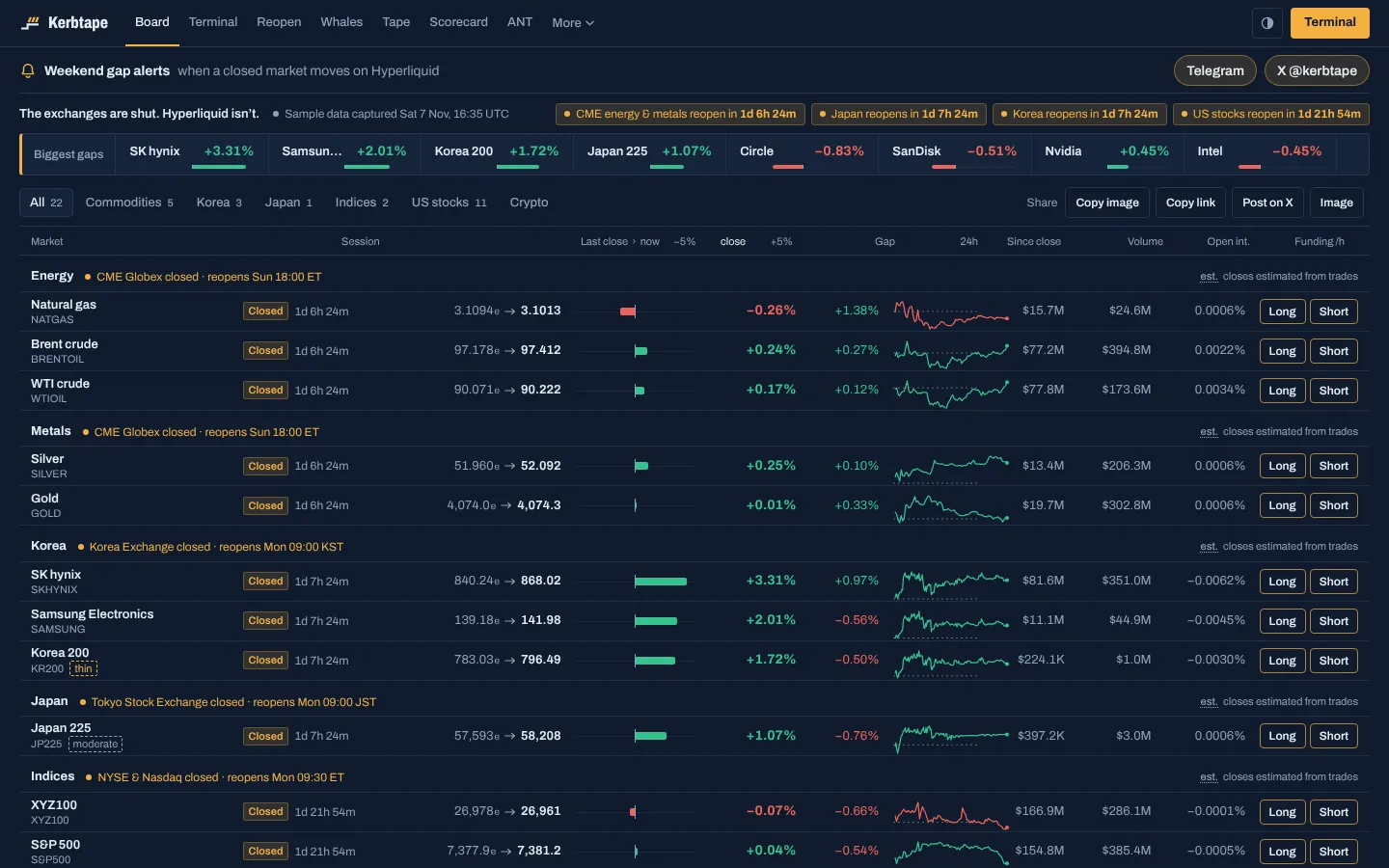
The board's home page lists every market whose home exchange is shut but which keeps trading on Hyperliquid, and how far its price has moved since that exchange closed.
The gap#
The gap is now ÷ last close − 1, shown as a signed percentage.
- Last close is the market's price on Hyperliquid at the minute its home exchange closed: for example 16:00 ET on Friday for US stocks, 15:30 KST for Korea, 15:30 JST for Japan, 17:00 ET for CME energy and metals. It is a proxy for the official close, not the exchange's own closing price.
- Now is the mid when the book has both sides, otherwise the mark price.
- A gap is shown only while the home exchange is closed. Open markets show their 24-hour change instead.
Some last closes are estimated from Hyperliquid trades because no oracle snapshot was captured at the close. They carry a
small e (or est.), and the methodology page says how they are made.
Gap vs the last real price#
Several markets keep real prices after the cash close: US stocks trade after hours and overnight until 20:00 ET on Friday, Korean stocks until 20:00 KST, and Korea 200 and Japan 225 follow index futures into the night. Until then Hyperliquid's oracle follows those real prices, so part of a gap may already have traded on a real market. Where the board captured that moment it also shows the move since real pricing stopped: only that part is weekend price discovery.
The reopen countdown#
The session chip on each row says whether the market is closed and counts down to the reopen: the moment Hyperliquid's oracle goes back to following real prices. For most markets that's the home exchange's open. US stocks come back earlier, in the overnight session (Sunday 20:05 ET), and US indices, Korea 200 and Japan 225 come back with their index futures on Sunday evening (US time). Those chips say "real pricing resumes" and name the later cash open next to it. The terminal uses the same times.
Reading the table#
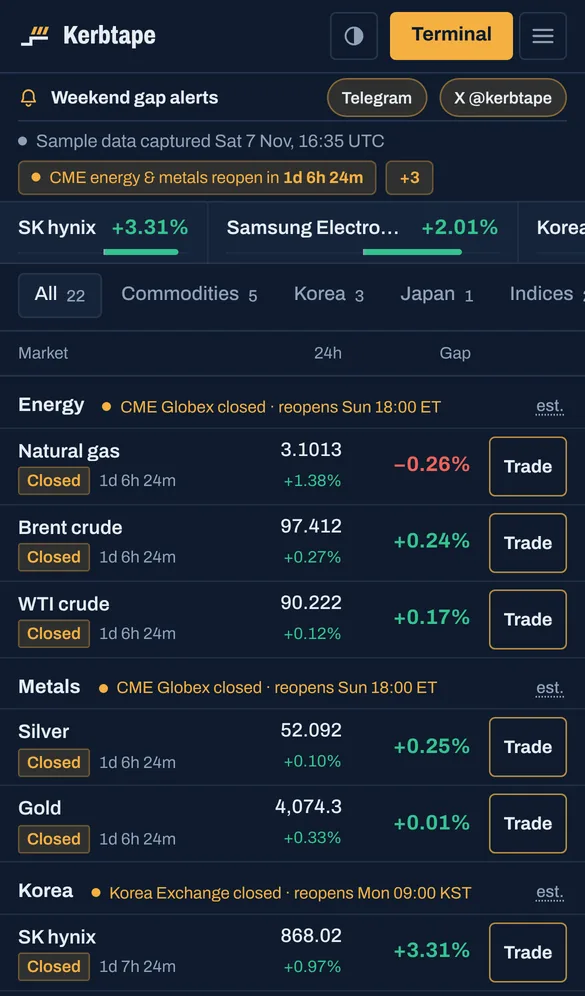
- The tape under the top bar shows up to 8 of the biggest gaps. It scrolls sideways on a phone.
- Class tabs filter by group (Korea, indices, commodities, US stocks, Japan…), each with a count, plus Crypto, which lists Hyperliquid's own crypto perps (top 40 by volume).
- Columns: market; session chip and countdown; last close → now; the gap bar; the gap; 24h change; a sparkline since the close; volume; open interest; funding per hour; and, where trading is offered, Long and Short buttons that open the terminal's ticket (nothing is sent from the board). On narrower screens columns drop from the right.
- Sorting: click Market, Session, Gap, 24h, Volume, Open int. or Funding. Clicks go descending, ascending, then back to the grouped view.
- The gap bar grows right for a positive figure and left for a negative one, on a compressed scale so small gaps stay visible.
- Liquidity tags: "thin" means under $250k of 24-hour volume and under $5M of open interest; a few small trades can move such a price. "moderate" means under $1M of volume and under $25M of open interest.
- Delays: a market with no price from Hyperliquid for over 5 minutes says "No recent price" and shows no gap. If the whole board's newest price is over 5 minutes old, a banner says how old the prices are.
The reopen desk#
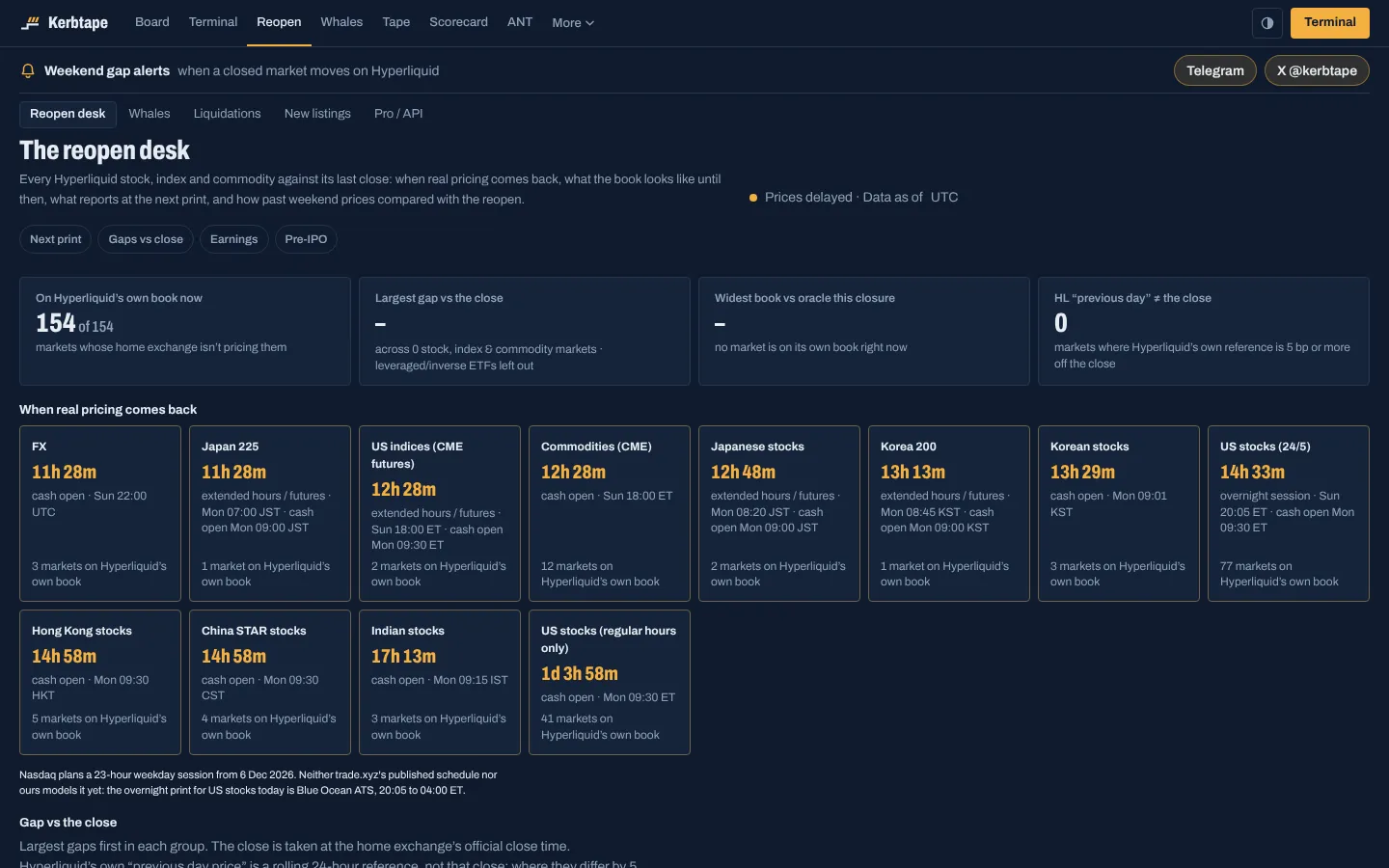
The reopen desk puts the weekend on one page: when real pricing comes back for each market, reopen risk market by market (most open interest first), the gap against the close, this week's earnings by the session they first trade in, pre-IPO markets, and the reopen scorecard.
Weekend history#
Weekends lists every graded weekend, and each market with a history has its own page under /history: Friday's close, the final weekend print, the reopen, and whether the weekend price landed closer to the reopen than the close did.
The full definitions are on the methodology page.
Updated . These pages describe what the product does. They are not investment advice and say nothing about where any price goes next.